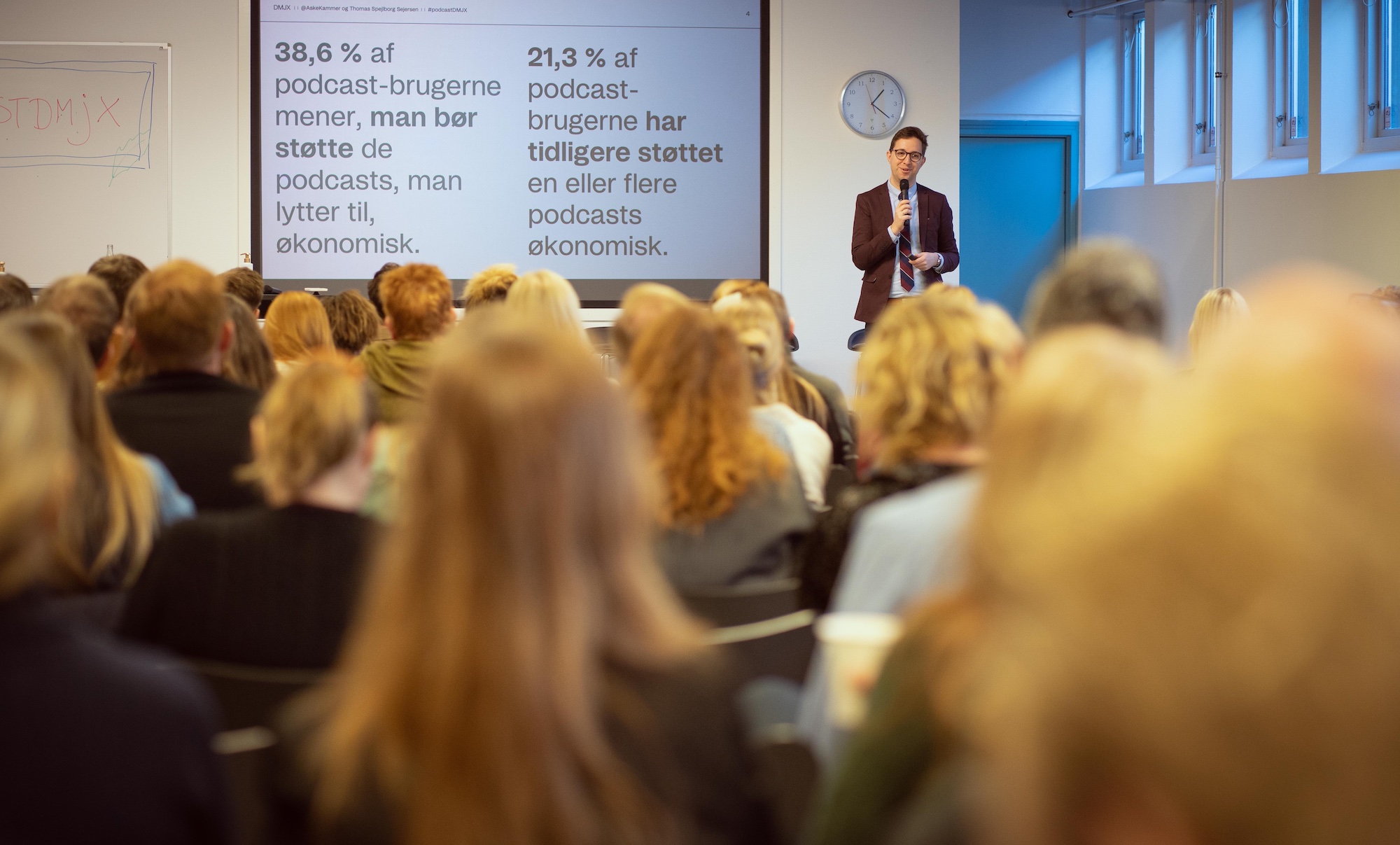
There are more and more podcasts. More and more people listen to podcasts. And those that listen seem to listen more and more (with the important caveat that because of the covid19 pandemic, people spend less time on commuting and, as a consequence, less time on listening to podcasts). Leading actors such as Spotify (that signed Joe Rogan and acquired Gimlet Media) bet on podcast as a part of their futures, and a medium as popular as podcast should do well in a digital economy centered around attention. Some do, even in a small language community like Denmark. But for most actors in the market, there is still no sustainable business model.
Against this background, we aim at mapping the business models in play and explore possible avenues for podcasts to build sustainable futures.
The project runs through four stages: 1) a quantitative mapping of the business models of all Danish podcasts; 2) interviews with actors in the market; 3) interviews with audiences; and 4) a representative survey among audiences. Taken together, these different data sources will enable
The project starts now and ends formally with a public conference in January, 2022.
Disclaimer: the Aller Foundation is closely connected to Aller Media, which recently acquired the podcast production company Heartbeats. They obviously have more than a philantropic interest in the project. However, DMJX, Thomas, and I have complete freedom to shape the project, conduct the analyses, and publish the results as we see fit.
In the global and digital media landscape, international streaming services such as Netflix and Amazon Prime become more and more popular. In Denmark, they account for increasing shares of viewing, and Danes spend increasing amounts of money on streaming. A recent report from the Agency for Palaces and Culture maps this development (the report is in Danish).
In order to support the production of Danish audiovisual content, the Danish government has decided to make it mandatory for streaming services to contribute to such production. The current media-political agreement says that streaming services must “invest 2 percent of their turnover in Denmark in the form of direct investments in new, Danish-language content” (my translation). The exact model for this scheme is, however, not outlined yet.
Contributing to the legislatory process, I gave testimony to the Culture Committee of the Danish Parliament earlier this week. My key argument was that in the process, legislators should consider the distinction between content-producing actors (such as Netflix, HBO Nordic, and Amazon Prime) and structures for distribution (such as YouTube and Vimeo). They operate with different business models, customer bases, and purposes. Some are financed through subscription, some through advertising. And some are hybrids; YouTube, for example, operates both its well-known video-sharing platform and the subscription-based YouTube Premium with unique content.
The manuscript for my testimony is in Danish and can be accessed here.
Last week, I tried something new (and fun): I invited everyone to join me at work. Not physically but through the @medpaarbejde Instagram profile. It is a profile that different persons take over each week in order to offer a glimpse into what different work situations look like. I am not on Instagram, but I figured this would be an interesting way to show what life in research looks like – and to paint a more nuanced picture of what goes on in universities.
My run is over now, but here is the collection of the 30 posts I managed to make during the week. They are in Danish, but an image speaks more than a thousand words, right..? The content still holds for what was a fairly typical week for me (even if the specific content of some of the events varies).
One note: you may notice that there are not very many persons in the pictures. This is not because I do not see people, but simply because getting consent to photograph them and put their face on Instagram took too long time…
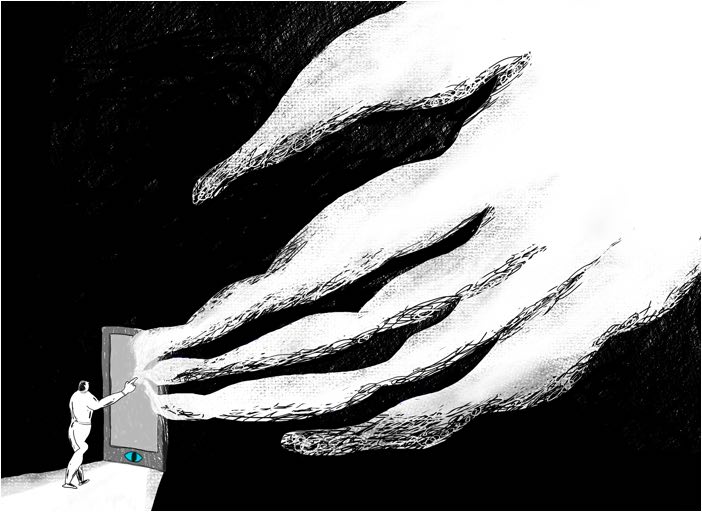
Today, Danish elite newspaper Information publishes onop-ed by me on “big tech”‘s capture of user data through perforated websites of public institutions in Denmark. The op-ed, which is in Danish, is part of a larger theme on surveillance capitalism. And it is publicly available here with an equally creepy and awesome illustration by Emilie Noer Bobek.
A few days ago, Kjetil Sandvik passed away. This is my obituary (in Danish), posted on the website of SMiD.
Kjetil Sandvik er død, blot 54 år gammel.
Han var lektor på Institut for Medier, Erkendelse og Formidling på Københavns Universitet. Han ledede det kollektive forskningsprojekt ”Meaning Across Media: cross-media communication and co-creation” (2012-2015), som var finansieret af Det Frie Forskningsråd, og han deltog i utallige andre projekter. Netop det tværmediale spillede en stor rolle i Kjetils forskningsvirke, hvor han gennem en årrække publicerede vidt og bredt om menneskelig aktivitet på tværs af medierne – i bøger, antologi-kapitler, tidsskriftsartikler og populær formidling. Men han arbejdede også med krimi-fiktion og med dødens og sorgens medialisering, sidstnævnte i nært samarbejde med sin hustru Dorthe Refslund Christensen. Og han udviklede interaktive spil og digital kulturformidling sammen med museer og biblioteker; på det punkt var Kjetil en atypisk akademiker, der ikke blot var en bogorm, men holdt fast i den udførende og afprøvende praksis, han havde med sig fra dramaturg-uddannelsen og det kunstneriske miljø.
Kort inden hans alt for tidlige død udkom hans bog Tværmedial kommunikation, som på mange måder var kulminationen på hans store og mangeårige bidrag til forskningen i cross-media communication. Også dér har Kjetil sat et stort og varigt aftryk på den danske medieforskning.
Kjetil var ledende redaktør for tidsskriftet MedieKultur fra 2013 og til sin død. I den periode blomstrede tidsskriftet, og især ”klassiker-projektet” med danske oversættelser af nogle af medie- og kommunikationsforskningens kanoniske tekster var en redaktionel genistreg. Det gjorde tidsskriftet endnu mere relevant for undervisere og studerende, og det var vigtigt.
Jeg var selv kort inde og vende i redaktionen, mens Kjetil ledede den, og skønt jeg kom længere og længere bagud med mine arbejdsopgaver og til sidst måtte kaste det fra mig, oplevede jeg aldrig andet end støtte og forståelse fra hans side. I dette tilfælde var støtten og forståelsen ikke fortjent, må jeg ærligt indrømme. Men Kjetil passede på andre, og han skærmede os – men måske glemte han at passe på sig selv? For han var drevet af en idealisme og et ønske om at gøre det så godt for alle omkring ham. Han var generøs med sin tid og med sit arbejde, men han sparede ikke sig selv. Han var en af de gode, og han vil blive savnet. Han bliver allerede savnet, kan jeg mærke på mig selv og på samtaler med gode venner og kolleger.
Jeg fik den umådeligt sørgelige besked om Kjetils død midt i SMiDs bestyrelsesmøde i tirsdags, og siden har jeg flere gange tænkt på én bestemt episode. Den udspillede sig på et institutseminar i Mölle i januar 2010, umiddelbart inden jeg påbegyndte arbejdet med mit ph.d.-projekt. Her betroede Kjetil mig, at selv som lektor lider man af imposter’s syndrome, så jeg skulle ikke lade mig gå på af den tvivl på egen berettigelse, vi alle oplever i mødet med universitetsverdenens mange lysende intelligenser. Det tog måske 10 sekunder. Men det øjebliks sårbar venlighed betød alverden for en ung og nervøs forskerspire, og dét vil jeg huske Kjetil for.
Kjetil efterlader sig kæresten Dorthe og datteren Silje. De skal vide, at vi er her for dem, når de har brug for det.
Resten er stilhed. Æret være Kjetil Sandviks minde.
Digital journalistik er et relativt nyt fænomen, der på én gang udfordrer og viderefører journalistikken, som den har set ud gennem det seneste århundrede. For digital journalistik omfatter brugerdeltagelse, deadlines hvert 5. minut og mediekonvergens såvel som traditionelle redaktionelle rutiner og klassiske journalistiske værdier. På den måde er det en paradoksal størrelse, der spænder over både forandring og kontinuitet, og som fortsat rummer et stort udviklingspotentiale i det digitaliserede samfund.
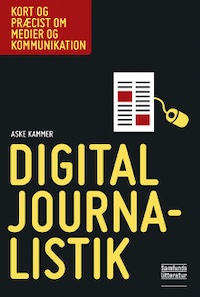
Det er i korte træk det, min nye bog Digital journalistik handler om. Den har været (for) længe undervejs, men jeg er meget glad for og stolt over, at den nu er udkommet på det danske forlag Samfundslitteratur som en del af deres serie Kort og præcist om medier og kommunikation.
Bogen er skrevet som en kort (110 sider) og letlæst introduktion til den digitale journalistik og dens formater, forandringer og forretningsmodeller. Fokusset er primært på danske forhold, men der inddrages også eksempler fra den internationale medieverden. Så den kommer omkring Berlingske, Ekstra Bladet og Tyngdepunkt såvel som New York Times, Verdens Gang og Tuscaloosa News.
Den er primært rettet mod medie-, journalistik- og kommunikationsstuderende – på sin vis er den skrevet som den bog, jeg selv manglede, da jeg underviste i medievidenskab og journalistik. For at gøre bogen særligt velegnet til undervisning, afsluttes hvert kapitel af en liste med anbefalet videre læsning samt arbejdsspørgsmål til undervisnings- og eksamensbrug. MEN: Jeg har gjort mig umage for, at bogen også bør kunne læses af andre, der er interesserede i journalistikken og dens udvikling i den digitale tid. Så den er altså ikke kun til studerende.
Jeg håber, I vil gå ombord i Digital journalistik, at den kan være til om ikke ligefrem glæde så gavn, og at I vil tage godt imod den. God læselyst.
PS: I forbindelse med udgivelsen deltager jeg i et par arrangementer. Vigtigst er et dobbeltarrangement med dygtige Anette Grønning fra SDU, hvor vi taler om vore respektive områder (hendes er digitale samtaler), og forlaget byder på forfriskninger. Det finder sted 5. februar kl. 15:15-17:15 på Syddansk Universitet i Odense og 28. februar kl. 15-17 på IT-Universitet i København.
To kick off the new year, the communications department at the IT University of Copenhagen asked five of its researchers which digital trends would shape 2017. The list primarily concerns technical stuff (the blockchain, AI, etc.) – but while I do not disagree with my distinguished colleagues, my prediction was of a more cultural kind:
One discussion that will definitely influence 2017 is about ‘digital intermediaries’ and their democratic responsibility (or lack thereof). Players like Google and Facebook are at the heart of our society’s communicative infrastructure – but the question is whether they are neutral actors who simply provide a platform for intercommunication between citizens. Or whether these services, because of their automated sorting and selection of the content that users are exposed to, are responsible for the quality of the highlighted content.
This discussion has been simmering for a long time, but in the wake of the US presidential election and the circulation of ‘fake news’, it has exploded, and the considerable interests at stake suggest that the debate is unlikely to end anytime soon.
We have something related and super-exciting in the pipeline in the Spring – but I’ll get back to that later. In the meantime, if you think this subject is interesting, I suggest you spend 47 minutes watching Rasmus Kleis Nielsen’s keynote “Platforms and Publishers” from the 2016 ECREA conference.
What is the role of digital journalism in journalism education?
It is an important question, and it is one that I have discussed and thought about more than usually since yesterday. The occasion is an opinion piece by Signe Okkels on Journalisten.dk (the trade journal for Danish journalists) where she critiques the journalism study programs in Denmark for not taking the digital dimension serious even though the digital is probably here to stay. Okkels studied journalism at Roskilde University and her point of comparison is a nine-months program at University of Southern California. Her conclusion:
“The level of Danish journalism education must simply be improved, and that calls for a different prioritization of and attitude toward digital journalism.” (translated by me)
It would be easy to just dismiss the critique as anecdotal (“well, that’s just her experience”) and off the mark (what does Okkels know about the other journalism educations in Denmark, including the one I work at?). But I actually think that, to some degree, she has a point – and her piece certainly struck a chord among people in the news industry:
@KV_Villumsen@SigneOkkels Den store udfordring er, at der rykkes så langsomt på noget, der er langt foran, når uddannelsen først er klar… — Heine Jørgensen (@heinekanten) September 14, 2015
Hvor er det her rigtigt. – til gengæld har der aldrig været bedre muligheder for at præsentere journalistik spændende http://t.co/Nr53S98cBn
The people tweeting here are obviously ones who pay more attention to the digital and will likely place more emphasis on it than your average editor or journalist (for one thing, they discuss this matter on Twitter…). But that does not disqualify their points of view. On the contrary: they work with the tensions and conflicts that surround the digital in newsrooms on an everyday basis. They know what this is about. For that reason alone, it would be wrong for journalism educators to just discard Okkels’ piece.
I agree with much of what Okkels and her tweeting supporters say. At the journalism study programs, we can do better in integrating digital with everything we do. Or rather, we should stop treating digital as a distinct category and instead teach our students to work with writing, audio, and visuals across all media. Instead of teaching “television and radio”, we should teach “moving images and sound”. We should teach our students about emerging business models, social media skills, WordPress, scraping, and the basic principles of coding as integral parts of the existing curriculum. In many instances, we should get rid of the “digital” prefix – nobody talks about “analogue” or “electronic” journalism, right?
But the thing is – and this is where I respectfully disagree with Okkels’ assessment of current journalism education in Denmark – that we already do much of this. At least at the Centre for Journalism at SDU where I work; what the other institutions do, I cannot speak for. We do not do it all the time, and we do not do it everywhere. But in our “old” MA program, my “J-Lab” course on media innovation and concept development in a transformed media environment is now mandatory. And on the new MA program, which just started on September 1, digital is one of the three cornerstones: the students must make their own websites and publish on it, they learn to write and produce audio and video for whatever platform they choose, and they will spend half a year on a “digital project” in collaboration with media organizations. It is our explicit ambition that these students excel at being digital journalists when they graduate.
I do not mean to be self-congratulatory, because we are not there (wherever that may be) yet. Could we move faster? Yes. Should we move faster? Yes, I think so. Should we be more agile and adapt to changes faster than we do? Yes, of course.
It is one thing that universities are slow organizations with above-average institutional inertia. But Magnus Bjerg from Danish TV 2 raises an important issue in his tweet as does Pernille Holbøll from free daily MetroXpress: not very many students are actually all that interested in the digital. Their observation corresponds with my own experiences from teaching our students and what I hear from colleagues on other Danish universities. Sure, digital is fine and all, but what really matters is getting your byline on the front-page of the printed newspaper or in the evening news. In that context, it is sometimes uphill for educators who actually want to push things in a digital direction (but we can, of course, be better – I am not making excuses). That is also a serious challenge for the news organizations now and in years to come, no doubt about that.
I cannot help thinking that all of this connects somehow to another issue that journalism education at universities must deal with: the theory vs. practice issue. While most professors, themselves socialized in an academic system, are interested in giving their students as much knowledge as possible, most students are interested in practicing journalism and learning the tricks of the trade. They do, after all, study journalism in order to become journalists.
But as Kurt Lewin put it, “There is nothing so practical as a good theory.” A theoretical perspective can inform practice and distinguish the reflexive practitioner from the one who is just doing a job. I strongly believe that in times of rapid and profound contingency changes, practitioners are better off with more theoretical knowledge, not less. And I do not necessarily see a conflict between the theory and practice when they can be mutually informing.
You can, with all due respect, always learn to make a timeline with Timeline.js and embed it on your site, but seeing through the communicative structures of the hybrid media system is not necessarily something you can just do just as good without being familiar with Chadwick’s scholarship.
One example (anecdotal, I am afraid): in most of my under-graduate courses, I at some point present Habermas’ theory of the public sphere to the students. Even though I am quite explicit about my reasons for doing so, I cannot escape the feeling that only the smartest of the students actually grasp why this is important (it proposes one very influential framework for understanding journalism’s raison-d’être), and even they would rather be out there interviewing sources for their next piece of journalism… It will sometimes (often?) be years, before they get the “oh, that’s what he was talking about” moment.
The challenge is that theory is abstract, insights come slowly, and this type of knowledge often exists as a reservoir of understandings that help inform what one does but not always in an explicit or obvious way. Practical skills are concrete, they can be acquired on a basic level fast(er), and they are part of everyday professional life. I understand why students (and their employers-to-be) do not always appreciate the need for and relevance of theory here and now when they could improve their practical skills. (By the way, the tension is of course not new. In 1958, it was what kept the conflict going between Doris Day and Clark Gable in the movie Teacher’s Pet.)
But I think it will be a slippery slope to just focus more on the practical skills, even though they are in high demand, at the expense of the theoretical dimension. Rather, I think we need to re-calibrate the journalism study programs in line with what I have mentioned above. I think we are doing the right thing with our new MA program. And I think we as researchers and educators at journalism study programs could be better in articulating why theoretical approaches can be useful for the students and the news industry. American scholars like NikkiUsher and Mark Coddington are extremely good at this; we can learn from them.
The critique from Okkels and others has two dimensions, one that has to do with what we do (where I actually think we might be a little more digital than we are given credit for) and one that has to do with our pace of adapting (where I think we could be better). Within the structural framework of universities, we – and again, I cannot speak for other than myself and my closest colleagues – try to work with these issues in a way that does not compromise scholarly quality; as C.W. Anderson has argued, one of the unique features of academia is that we actually have time and are expected to think hard about our objects of study, which takes a lot of time. Sometimes the slow approach is the best way to generate new insight, even though it obviously clashes with rapid and radical transformations that take place here and now. I do not mention this as an excuse, rather as an explanation. And it does not exempt us from being digital enough in our teaching. We can do more in that area.
If I should wish for something in return, it would be that our students embrace the digital more than they do today. It is, in all likelihood, where many of them will spend their entire career, but it is all too rare that a critique such as Okkels’ is put forth.
Full disclosure: The Danish community of journalism educators is small, and the circle of people teaching and researching digital journalism is even smaller. For this reason, I know the people Okkels critiques and even consider many of them good friends. I hope this has not clouded my judgment on this matter.
Update, September 15, 2015: The discussion has continued today, and I have added the tweet by Pernille Holbøll above. Furthermore, Filip Wallberg and Mads-Jakob Vad Kristensen have contributed to the discussion on their respective blogs; their basic argument is that starting one’s own medium should be mandatory for all journalism students.
Back from the NordMedia 2015 conference in Copenhagen. It is the biannual media researcher conference for the Nordic countries (in 2013, it was in Oslo), and this time (as in Oslo) it was a very good experience. Congratulations to my former colleagues at the Department for Media, Cognition and Communication at the University of Copenhagen for successfully organizing the conference – in particular, I applaud the efforts of Anne Jerslev and Christa Lykke Christensen, who served as chairs of the organizing committee.
On the conference, I presented two of the projects I am currently working on.
First, I had organized a panel on “Journalism and Social Media”, where Ulrika Hedman (Gothenburg University), Anders Olof Larsson and Christian Christensen (Oslo University and Stockholm University, respectively), and I presented our research on, well, journalism and social media. While the papers by Ulrika and Anders/Christian were empirical pieces with analyses of large data sets, my own paper was of a rather theoretical character, discussing the relationship between the private, the personal, and the professional on journalists’ social media profiles. It was very much a work-in-progress, but I expect it to be a finished article ready for submission to a journal later this year.
I know Anders from my visiting fellowship at Oslo University earlier this year, and Ulrika and I have kept on online conversation going for the last couple of years since our research interest into social media journalism are very closely connected (but for some peculiar reason we had not actually met in persons before the NordMedia conference – very nice to finally do so). For me, it was quite a “dream team” of scholars that participated in the panel, and the presentations certainly met my high expectations. All in all, I think the panel was a success – not least thanks to the insightful questions and smart comments from the audiences.
As social media have proliferated extensively over recent years, they now play an increasingly important part in journalistic practices and in the workings of news organizations. Having a de-centralized and distributed character, social media constitute a very different communicative structure than traditional mass media, which are built upon the logic of one-to-many communication. Hermida (2014), for example, identifies Twitter as an “ambient news network” because of the constant and multi-directional exchange of information, journalism, opinions, and social intelligence on the social medium. Furthermore, journalists are not the only ones on social media conducting journalism, and not all activities performed by journalists on social media are of a journalistic nature.
So, the established order of journalism is challenged since social media induce alternative, more personalized, ways of expressions and flows of public communication into the workings of the mass media system. The questions, then, are how actors, organizations, and institutions rooted in the “old” media system accommodate to the “new” media platforms, and how their routines and practices change because of them.
The panel brings together researchers from Norway, Sweden, and Denmark. It consists of three papers, which complement each other in approaching the how social media influence journalism and the ways news media and news workers work from different perspectives (participatory practices, “social media logics”, sociological role theory) and with different methodological frameworks (content analyses, case studies). Together, they address the multi-facetted responses to the challenges brought about by social media and the heterogeneous research that currently maps these developments.
Second, I presented a paper (again, work-in-progress) about media policy responses to the convergence of news media sectors in Denmark (to some degree a re-run of the paper I presented at the 2nd International Conference on Public Policy in Milan last month). Here, I am still collecting the last pieces of data from the political parties eligible to run at elections for the Danish parliament, but I expect the article version of this paper to be published next year.
I almost always find it enjoyable to attend conferences and present my work. But the NordMedia conferences are something special because they constitute an opportunity to see all the good colleagues from the Nordic countries – many of whom I have know throughout most of my academic career and almost consider my “research family”. So I am looking forward to the 2017 conference in Tampere, Finland.
Lee Humphrey’s excellent key note speak on “The Qualified Self” where she, among other things, argued that the sociality and (perceived) self-indulgence of social media is nothing new but rather goes back to the format of the diary in the 19th century. (I unfortunately missed Klaus Bruhn Jensen’s keynote on meta-communication.)
The planning of future collaborations with colleagues in Denmark and abroad. One of the strengths of the NordMedia setup is that it facilitates and encourages international comparative work, and after my meetings with some amazingly smart people, there are interesting projects in the pipeline.
Being elected chair of the Journalism Studies division of NordMedia.
A large part of the dissertation consists of research articles, and most of those are now published in academic journals (in more or less revised versions):
Furthermore, parts of the theoretical introduction is commissioned as a book chapter for publication next year. I’ll post more on that here on the blog later.
If you want the printed-book version, it is for sale at Publikom at the price of 172.50 DKK (approx. 32 Euros/31 USD). For some reason, they haven’t added the dissertation to their online catalogue even though they sell it, so you’ll have to send them en email.
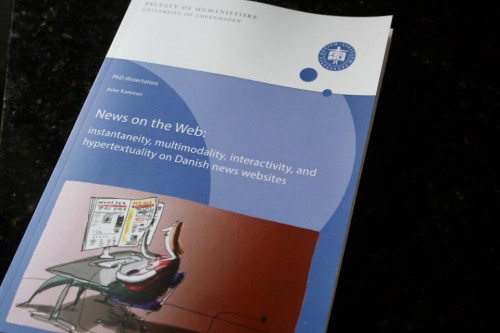
Tomorrow, I’ll publicly defend my PhD dissertation News on the Web: instantaneity, multimodality, interactivity, and hypertextuality on Danish news websites. The defense will take place in auditorium 22.0.11 at the Southern Campus of the University of Copenhagen, and I think it’s going to be quite interesting; at least, it will be very satisfying for me. The dissertation is the result of three years of work, and even though I still think the subject – digital journalism and how it’s changing, transforming, and maintaining institutional arrangements – is highly interesting and relevant, it will be good to achieve closure on this project. I need to move forward to something new (but, of course, related) in terms of research work, and the defense marks the first step in such a transition.
I’ll provide a write-up of the defense in a later post. With this one, I actually just wanted to invite everybody to the defense (it is public, after all, and I’d like the results of my work to reach as many people as possible), to show a picture of the dissertation fresh from the press, and to publish the following summary of my work. The summary is taken from the dissertation, and it goes through the main points of it very briefly.
Compared to traditional news media, news websites hold a unique set of affordances in relation to news workers, namely instantaneity, multimodality, interactivity, and hypertextuality. This constellation of affordances constitutes a particular condition for the production and presentation of news. This dissertation is an enquiry into how institutional actors (news workers) appropriate these potentials afforded by new, digital technology (news websites).
The enquiry is conducted with an integration of quantitative and qualitative methods, and the analyses generally support the hypothesis that news workers working on Danish news websites do, indeed, make use of the four affordances, and that they do so in ways so that they maintain journalistic control in the process. The analyses include a content analysis of formal features on 93 Danish news websites, a qualitative case study of real-time coverage of emergent crisis, and a theory-building case study of audience participation in news production for news web-sites. The dissertation propose mediatization theory as a means for contextualizing the current developments within the institution of journalism, arguing that it is an institution which is accommodating the logics and formats of the media institution – but not without some resistance from its actors.
The dissertation consists of introductory chapters (Introduction, Terminology, Theoretical framework, and Research design), four research articles, and a concluding chapter, which outlines the conclusion, identifies the most important contributions to existing knowledge, and points to future research in continuation of this dissertation. Except for one of the four research articles, this dissertation is written in English; the research article in question is Danish-language.
If you want to read the entire dissertation, drop me an email and I’ll forward it to you.
Yesterday, I received the best news in a long time – namely that my PhD dissertation News on the Web: instantaneity, multimodality, interactivity, and hypertextuality on Danish news websites has been accepted for public defence. That is great news as a surprisingly high number of PhD dissertations are not accepted at once but need to be rewritten and resubmitted. So yesterday was a day of celebration for me and my wife.
I submitted the dissertation at the Faculty of Humanities, University of Copenhagen, on January 31 this year after exactly three years of researching and writing. The defence will take place on May 3, beginning 1pm, and will be open to the public. I will publish more information on the defence here on the blog later. Furthermore, I will also put out more information on the dissertation when my teaching obligations on the university allows for it. So stay tuned!
Update April 23, 2013: The defence will take place in auditorium 22.0.11 in Southern Campus of University of Copenhagen.
Having attended arrangements with both Annette Markham (more coming up on her in my next post) and Astrid Haug this week, I realized that I needed to go on Twitter if I ever wanted to be able to figure out what’s going on there. And as a researcher of news and journalism on the web, I want to do that. I’ve been reluctant to sign up to more social media platforms but now I’ve decided to give it a try. I might not be the most active tweeter (is that what it’s called?) but I’m excited to see where it takes me.
This Monday, my wife will hand in her magnum opus (aka master thesis) Orv, det’ for børn! Programlægning af børne-tv på danske public service-kanaler [“Waow, it’s for kids!” Programming children’s television on Danish public service channels] at the Department for Media Studies, University of Copenhagen. The thesis is about Danish public service broadcasters’ programming of children’s television and builds upon interviews and a thorough analysis of ratings. As far as we know, no such study has not been conducted in a Danish context before. By request from one of her interviewees, the thesis is not publicly available but I’ve been granted permission to post what I consider the most important paragraphs from the abstract here on the blog:
Ramasjang was an absolutely necessary initiative for DR who would most likely have lost the youngest audience without a children’s channel, because children do not bother waiting for programmes for them on the main channels. Public service television and Danish programmes, however, offer something else than the commercial channels and are as such important to keep as an alternative.
Concluding, I argue that DR ought to have two differently targeted children’s channels as Ramasjang has troubles serving both the 3-6 and 7-10 years old children. That way, DR would be able to program for a better flow with high ratings and simultaneously prioritise both audience groups equally just as the public service idea lies down.
I, of course, am in no position to objectively judge the quality of the work nor grade it – but I must say that I’m impressed by this piece of work. Congratulations, honey!
 Digital journalistik er et relativt nyt fænomen, der på én gang udfordrer og viderefører journalistikken, som den har set ud gennem det seneste århundrede. For digital journalistik omfatter brugerdeltagelse, deadlines hvert 5. minut og mediekonvergens såvel som traditionelle redaktionelle rutiner og klassiske journalistiske værdier. På den måde er det en paradoksal størrelse, der spænder over både forandring og kontinuitet, og som fortsat rummer et stort udviklingspotentiale i det digitaliserede samfund.